
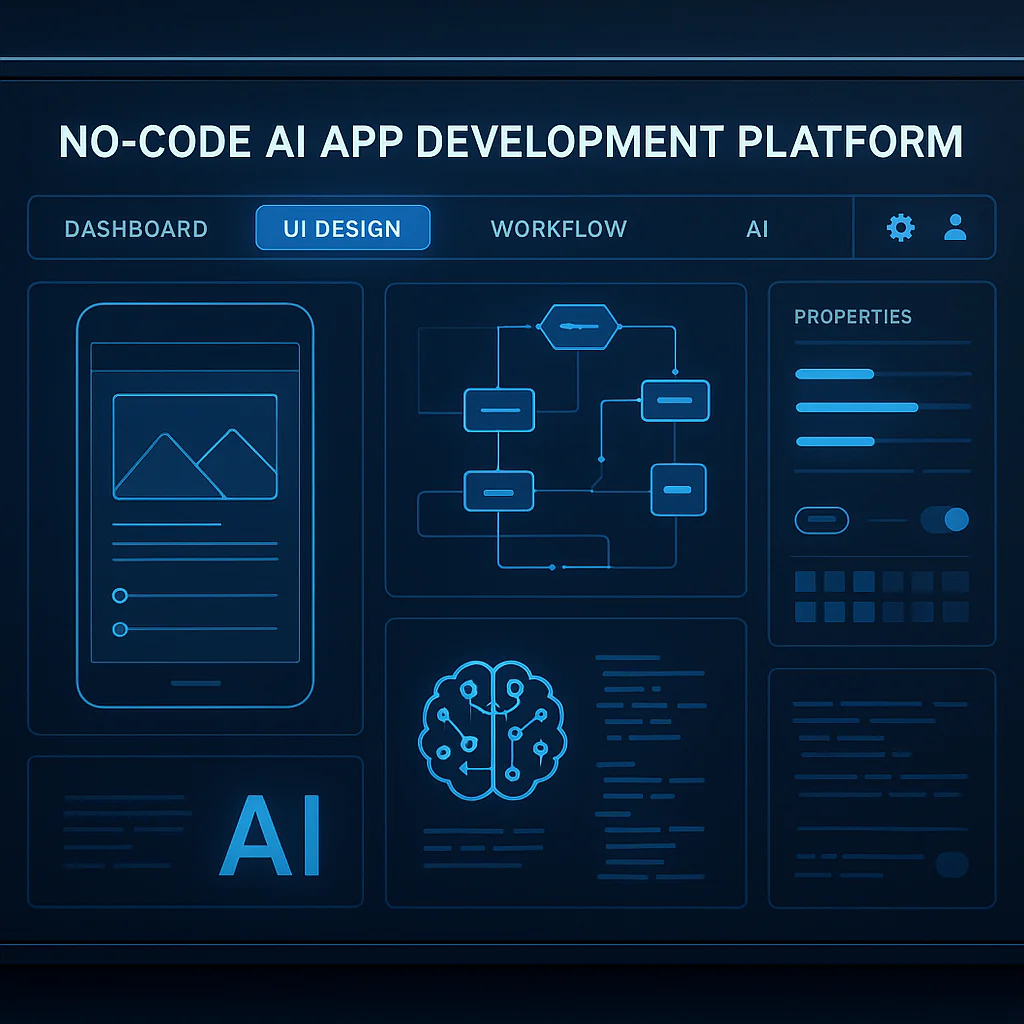
The future of no-code AI applications is a partnership between human judgment and increasingly capable tools: AI will make it faster to design apps, automate workflows, and work with business data, while people remain responsible for deciding what’s safe, useful, and ready to ship.
At App 9™, we see the biggest opportunity not in asking AI to build everything, but in helping people turn everyday problems into working prototypes. A team might start with a plain-language request for an app that sorts customer feedback, then refine its data connections, permissions, and review steps before anyone relies on it.
That distinction matters. No-code lowers the barrier to building; it doesn’t remove the need for good design, testing, or governance. Our guide to no-code AI app development explores the practical foundations, while this article looks ahead at what’s changing—and what businesses should prepare for.
Key Takeaways
- AI will make app creation more conversational: Expect natural-language prompts and copilots to help generate interfaces, workflows, and integrations.
- No-code AI will extend automation, not eliminate human oversight: High-impact decisions still need clear rules, testing, and accountable people.
- The strongest use cases start with a specific problem: Customer support, document processing, internal tools, and repetitive workflows are practical places to begin.
- Platform choice should follow the use case: Compare data access, security controls, integrations, scalability, and export options—not just how quickly a demo appears.
- Citizen developers and professional developers will increasingly work together: Business teams can prototype and maintain simpler apps; developers can focus on complex architecture, security, and custom systems.
- Governance is part of the product: Access controls, audit trails, privacy safeguards, and ongoing monitoring help keep AI applications reliable as they grow.
- The best forecast is measured optimism: No-code AI can speed up software creation, but it won’t magically turn an untested prototype into dependable production software.
Table of Contents
- ⚡️ Quick Tips and Facts
- 🧭 What Are No-Code AI Applications?
- No-Code, Low-Code, and AI-Assisted Development Explained
- How No-Code AI Apps Differ From Traditional AI Software
- 📜 From Visual App Builders to Generative AI
- A Brief History of No-Code and Low-Code Platforms
- How Generative AI Changed Application Development
- 🛠️ How No-Code AI Application Builders Work
- Visual Workflows, Data Connectors, and AI Models
- Natural-Language App Generation and Copilots
- From Prototype to Production Deployment
- 🚀 Why No-Code AI Is Growing
- Faster Prototyping and Rapid Application Development
- Citizen Developers and Broader Access to Software Creation
- Lower Bariers to AI Adoption Across Organizations
- 🔮 The Future of No-Code AI Applications
- AI Agents and Autonomous Workflow Automation
- Multimodal Apps for Text, Images, Audio, and Video
- Personalized Apps and Adaptive User Experiences
- Smarter Integration With Business Data and Existing Software
- On-Device AI, Open Models, and Private Deployments
- How Human Developers Will Work Alongside AI
- 🏆 12 Ways No-Code AI Is Changing App Development
- 1. Building Apps From Plain-Language Instructions
- 2. Automating Repetitive Business Workflows
- 3. Creating AI Chatbots and Virtual Assistants
- 4. Turning Documents Into Searchable Knowledge Bases
- 5. Analyzing Data Without Writing Code
- 6. Generating and Personalizing Content
- 7. Improving Customer Support and Service
- 8. Streamlining Sales and Marketing Operations
- 9. Supporting Healthcare and Other Regulated Workflows
- 10. Powering Internal Tools and Employee Experiences
- 11. Accelerating Prototypes and Minimum Viable Products
- 12. Connecting AI Models to Everyday Business Apps
- 🧰 Leading No-Code AI Platforms and Tools
- Microsoft Power Apps and Copilot
- Google AppSheet and Gemini
- Bubble, Zapier, and Make
- Airtable, Retool, and Other AI App Builders
- How to Choose a No-Code AI Platform
- ⚖️ Benefits, Limitations, and Trade-Offs
- Where No-Code AI Delivers the Most Value
- Common Risks: Hallucinations, Errors, and Fragile Workflows
- Platform Lock-In, Scalability, and Customization Limits
- When Custom Software Development Is the Better Choice
- 🔐 Security, Privacy, Governance, and Responsible AI
- Protecting Sensitive Data and Managing Access
- AI Accuracy, Testing, and Human Oversight
- Compliance, Audit Trails, and Intellectual Property
- Avoiding Shadow IT With Practical Digital Guardrails
- 🧑 💻 How to Build a No-Code AI App: A Practical Roadmap
- Define the User Problem and Success Measures
- Choose a Platform, Model, and Data Sources
- Design Prompts, Workflows, and User Experiences
- Test for Reliability, Security, and Accessibility
- Deploy, Monitor, and Improve the Application
- 📈 Business Adoption, Skills, and Team Readiness
- Building a Citizen-Developer Program
- Training Teams to Use AI App Builders Effectively
- Measuring Productivity, Quality, and Return on Investment
- ❓ FAQ
- Will No-Code AI Replace Software Developers?
- Can No-Code AI Apps Handle Enterprise Workloads?
- Are No-Code AI Applications Secure?
- Can You Build an AI App Without Coding Experience?
- What Is the Difference Between No-Code AI and AI Coding Assistants?
- What Should Businesses Consider Before Adopting No-Code AI?
- ✅ Conclusion
- 🔗 Recommended Links
- 📚 Reference Links
Table of Contents
- ⚡️ Quick Tips and Facts
- 🧭 What Are No-Code AI Applications?
- No-Code, Low-Code, and AI-Assisted Development Explained
- How No-Code AI Apps Differ From Traditional AI Software
- 📜 From Visual App Builders to Generative AI
- A Brief History of No-Code and Low-Code Platforms
- How Generative AI Changed Application Development
- 🛠️ How No-Code AI Application Builders Work
- Visual Workflows, Data Connectors, and AI Models
- Natural-Language App Generation and Copilots
- From Prototype to Production Deployment
- 🚀 Why No-Code AI Is Growing
- Faster Prototyping and Rapid Application Development
- Citizen Developers and Broader Access to Software Creation
- Lower Bariers to AI Adoption Across Organizations
- 🔮 The Future of No-Code AI Applications
- AI Agents and Autonomous Workflow Automation
- Multimodal Apps for Text, Images, Audio, and Video
- Personalized Apps and Adaptive User Experiences
- Smarter Integration With Business Data and Existing Software
- On-Device AI, Open Models, and Private Deployments
- How Human Developers Will Work Alongside AI
- 🏆 12 Ways No-Code AI Is Changing App Development
- 1. Building Apps From Plain-Language Instructions
- 2. Automating Repetitive Business Workflows
- 3. Creating AI Chatbots and Virtual Assistants
- 4. Turning Documents Into Searchable Knowledge Bases
- 5. Analyzing Data Without Writing Code
- 6. Generating and Personalizing Content
- 7. Improving Customer Support and Service
- 8. Streamlining Sales and Marketing Operations
- 9. Supporting Healthcare and Other Regulated Workflows
- 10. Powering Internal Tools and Employee Experiences
- 11. Accelerating Prototypes and Minimum Viable Products
- 12. Connecting AI Models to Everyday Business Apps
- 🧰 Leading No-Code AI Platforms and Tools
- Microsoft Power Apps and Copilot
- Google AppSheet and Gemini
- Bubble, Zapier, and Make
- Airtable, Retool, and Other AI App Builders
- How to Choose a No-Code AI Platform
- ⚖️ Benefits, Limitations, and Trade-Offs
- Where No-Code AI Delivers the Most Value
- Common Risks: Hallucinations, Errors, and Fragile Workflows
- Platform Lock-In, Scalability, and Customization Limits
- When Custom Software Development Is the Better Choice
- 🔐 Security, Privacy, Governance, and Responsible AI
- Protecting Sensitive Data and Managing Access
- AI Accuracy, Testing, and Human Oversight
- Compliance, Audit Trails, and Intellectual Property
- Avoiding Shadow IT With Practical Digital Guardrails
- 🧑 💻 How to Build a No-Code AI App: A Practical Roadmap
- Define the User Problem and Success Measures
- Choose a Platform, Model, and Data Sources
- Design Prompts, Workflows, and User Experiences
- Test for Reliability, Security, and Accessibility
- Deploy, Monitor, and Improve the Application
- 📈 Business Adoption, Skills, and Team Readiness
- Building a Citizen-Developer Program
- Training Teams to Use AI App Builders Effectively
- Measuring Productivity, Quality, and Return on Investment
- ✅ Conclusion
- 🔗 Recommended Links
- ❓ FAQ
- How will no-code AI applications change the way businesses build software?
- What are the best no-code AI platforms for creating apps without programming?
- Can no-code AI tools build scalable applications for businesses?
- Will no-code AI replace traditional app developers in the future?
- How can a business keep no-code AI apps secure and accurate?
- 📚 Reference Links