

Reviewed July 11, 2026. Product capabilities and prices change; verify the official sources during your trial.
Choose Replit when you want a general-purpose cloud development workspace and are comfortable making technical deployment choices. Consider App9 when the priority is a more guided product-building path for a defined business workflow. The deciding evidence is whether your team can operate the deployed app—not which assistant produces more code in a demo.
App9 and Replit overlap at AI-assisted software creation, but they start from different centers of gravity. Replit exposes a broad development environment. App9’s public positioning centers on describing, previewing, inspecting, and owning an app project.
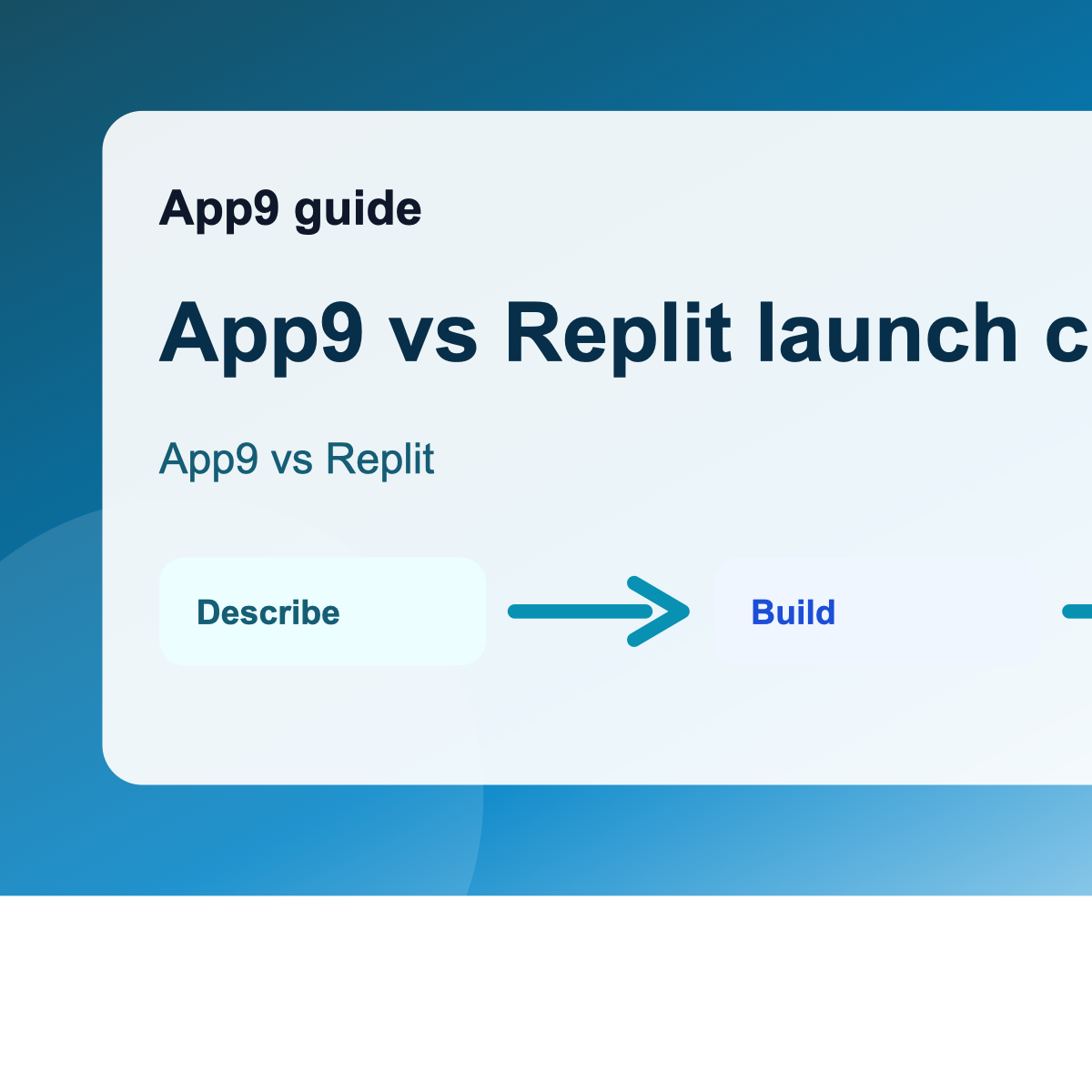
A decision framework that produces evidence
| Decision | App9 emphasis | Replit emphasis |
|---|---|---|
| Starting point | Business brief, users, data, and workflow | Cloud development project and AI-assisted implementation |
| Technical control | Inspectable code with a guided path | Broad editor, runtime, package, and deployment control |
| Deployment | Connected to the guided build experience | Multiple publishing/deployment types with usage-based costs |
| Best-fit operator | Founder or operator with a bounded workflow | Developer or technical builder who values flexibility |
| Proof to request | Export, permissions, logs, and recovery for your app | Deployment choice, spend controls, logs, and team ownership |
Score only what you can demonstrate in the same realistic project. Marketing pages help create the test plan; they do not count as a passing result.
Worked scenario
For an internal approval queue, both tools may reach a working screen quickly. Add the real test: a staff role, an administrator role, server-enforced permissions, a failed email, a rollback, and an export opened in a clean environment. That exercise exposes whether “launch” means a URL or an operating system the team understands.
Five checks before you commit
- Can a non-technical owner understand the release state?
- Can a technical maintainer inspect and change the project?
- What triggers paid deployment usage?
- How are secrets and environments separated?
- How quickly can the team roll back a bad change?
Run a fair two-project trial
Use one small project to learn the tool and a second project to test the decision. The decision project should contain a customer-facing action, a staff action, durable data, at least two roles, one integration, and one failure state. Give every finalist the same brief and acceptance criteria. Record when expert intervention is needed instead of quietly rescuing one candidate.
- Baseline: create the thin workflow with realistic seed data.
- Change: add a role, a relationship, and a validation rule without starting over.
- Adversarial check: try a forbidden record request and a malformed input.
- Operations check: find the useful error, usage view, release history, and recovery path.
- Exit check: export the project and list what would be needed to run it elsewhere.
Weight the results before adding the scores. A public calculator may value speed and visual polish most. A customer portal with private documents should give more weight to authorization, recovery, and ownership. A zero on a must-have requirement is a stop sign, even when the overall average looks attractive.
For a reusable method, open the App9 explanation, prototype-to-production checklist, scorecard. Keep screenshots, prompts, errors, exports, and dated pricing sources beside your decision.
Official sources
Editorial disclosure: App9.co is owned by AccelerMedia LLC, which operates App9 Builder. This article is not an independent review of App9 and does not claim unperformed hands-on testing. Competitor facts are linked to official sources; judgments are presented as a method readers can reproduce.